



Found SF — visit website
Your place to discover & shape San Francisco history
Have a San Francisco memory to share? Add to any of our unfinished articles — you can revise text, or add new images.
Comprised of over 2,500 pages, and over 10,000 historical photos, the wiki-based archive FoundSF.org is the product of hundreds of contributors, regular people who were compelled by the chance to investigate some piece of this City's past.
Collection Highlights and Recent Additions:
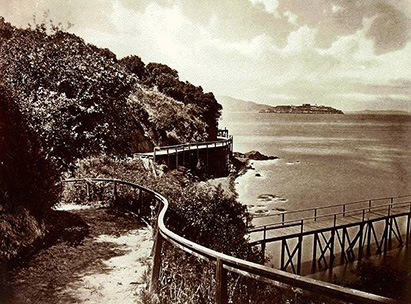
San Francisco's Drinking Water
The first attempt to build a piped water system began in May 1853, when the Mountain Lake Water Company broke ground on an ambitious brick tunnel beneath the Presidio, with the goal of delivering water from the Presidio’s Mountain Lake,(1) through the tunnel and into a wooden flume to the city. Two years later, the company had burned through its initial funding, and was unable to raise the money needed to finish the project.(2) So in 1857 the city government granted the water franchise, a legal monopoly, to a new company formed by John Bensley and Antoine (aka Anthony) Chabot, in return for providing water for firefighting and other "municipal purposes." Within a year, they had built a winding 7-mile redwood flume from Lobos Creek, at the west end of the Presidio, to a pumping station at today's Ghirardelli Square. The company also laid 14 miles of pipe and installed 100 fire hydrants. The first piped water reached customers on September 27, 1858.
Continue reading on FoundSF.org
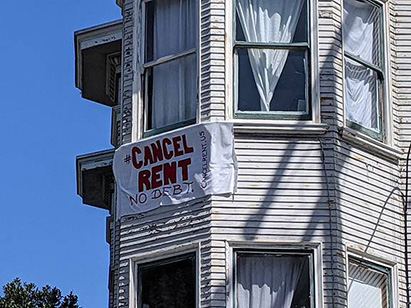
Covid-19: The Virus of Delegitimation
While I may be sick of wall-to-wall coronavirus in the media, and we’re all a bit stir-crazy with the physical distancing and staying home, I’m NOT sick of this luminous, sensuous, expansive, amazing HALT that we’re living through now. I’m cautiously excited about the profound crisis of legitimacy this pandemic is inducing in our already brittle, exhausted, and criminally insane society. Who hasn’t stopped to ponder the possibilities of NOT going back to “normal”? We had to stop working, stop producing that world, and after a healthy break to think about it, start producing the world we want to live in. Maybe the sudden devaluation of shopping, celebrity, and spectacle has enriched our lives and opened our senses to overlooked possibilities? Did we inadvertently stop and smell the roses?
Continue reading on FoundSF.org
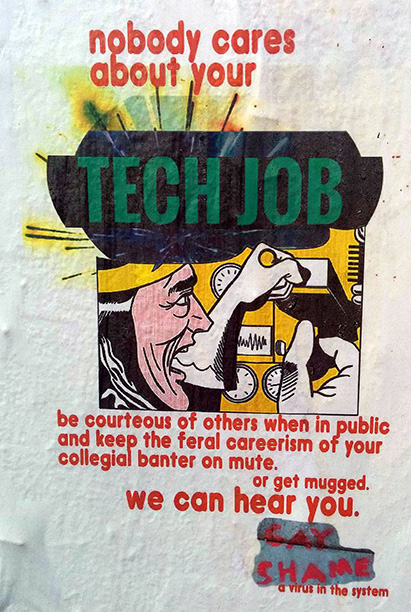
Gay Shame and the Politics of Resistance
As a radical queer fleeing to San Francisco in search of hope, the early nineties were a formative time for me. Nevertheless, I would not have guessed that scarcely a decade later, people would look upon that period with nostalgia bordering on delusion. No one is immune to such lapses in judgment. I too remember a time of cheap rent, artistic possibility, and radical direct-action activism, a time when there were almost as many freaks as yuppies, and “community” felt more like a possibility than an advertising gimmick. But I also re-member that, even if no one I knew in 1992 paid more than $300 rent, this felt exorbitant and unaffordable...
Continue exploring on FoundSF.org

Naming of Things: In the Pixel Mines of Video Game Localizing
I have found the place where making romantic sentences full of pathos and bravado has become factory work. On a plain of paved streets in Sunnyvale, past rows of ticky-tack Spanish-tiled roofs, in a cove of office-warehouses, holding herds of cubicles, there is a production line of typing, where heart-pounding humans —kinetically and incessantly— animate keyboards in order to weld words into the dialogues of fantasy video games. For a contractual month, I worked as an “English-Spanish Localization Consultant”, translating the tales and insults of warring races from English-to-Spanish. By my typing fingers, an arrogant Necromancer who once in English belittled an enemy as an “Impudent insect!” now cried “¡Insecto insolente!” His bloated claim of “I am immortal! You will never defeat me!” would soon after his defeat, now be followed by an incredulous wail of “¡Imposible, imposible!” ... In naming this world, I pronounced myself Genesis!
My contract named me otherwise. On page one I was defined as the “Consultant”. This was an intended disambiguation from that other archaic word: “employee”. A consultant maintains an “independent relationship” to the hiring company, while an employee has labor rights. As a “Consultant” I was contractually obliged to work nine hours a day, but was paid only eight, because as a “Consultant” I covered my lunch hour at my own expense.
The word “Consultant” gives the impression that a person is independent enough to own and control one’s own business, ignoring the implicit lack of power in taking a full-time job at $15 dollars an hour to translate video game dialogues. Fifteen dollars an hour is the amount that at the time the Day Laborer Program on Cesar Chavez Street recommended paying an undocumented immigrant worker for an hour of labor. Keeping in mind that the literary quality of video game dialogues emulate porn scripts, albeit with the differing objective of fucking the other party over versus fucking with them, as soon as possible, I agree that my work translating video games should not be compensated more than the manual labor of women and men who have crossed the Sonoran desert on heroic journeys. Yet, I was still surprised to learn that the phrase “independent consultant” had become synonymous to “day-laborer”. I began to properly call myself a “poor-fessional”.
Continue reading on FoundSF.org
 Visit FoundSF.org