



Rethinking Memorialization
Junipero Serra Statue Re-examined
Community Engagement
Shaping San Francisco, from March 2025–March 2026, was chosen as a Community Engagement Consultant by the San Francisco Arts Commission for the "Shaping Legacy: San Francisco Monuments and Memorials" project. For this case study, we examined memory and memorialization in relation to the Padre Junipero Serra monument (one of several public monuments toppled on Juneteenth 2020 in the wake of the May 2020 police murder of George Floyd) by facilitating artist activations, community history circles, and public events exploring this history. Four other monuments were explored by local community organizations: Christopher Columbus by California Migration Museum, Dewey Monument by SOMA Pilipinas, Francis Scott Key by Youth Speaks, and Ulysses S. Grant by American Indian Cultural District.
Part of Shaping Legacy: San Francisco Monuments & Memorials,
a project of San Francisco Arts Commission, with Adriana Camarena, Kim Shuck, and Chris Cuadrado. Thanks to Association of Ramaytush Ohlone for guidance throughout the year.
Shaping San Francisco’s year-long case study of the Padre Junípero Serra statue included a folklife-based, community-led research process centered on memory-keeping practices. Indigenous community researchers explored everyday practices from their own cultures that carry collective knowledge. The researchers included members of Urban Native communities, Indigenous migrants from Latin America and the Caribbean, and urban youth. Their research invites reflection on how genocide, relocation, and migration continue to erode Indigenous ways of knowing, and how communities continue to protect and hold on to them. The process was facilitated by storyteller Adriana Camarena.
These projects were developed through a participatory action research (PAR) process in which community members acted as researchers, identifying and documenting memory-keeping practices rooted in their lived experience, cultural knowledge, and community relationships. Each participant identified their focus through a guided process of reflection, dialogue, and collective inquiry. Rather than assigning topics, the process supported participants in recognizing existing practices within their own lives and communities as forms of memory-keeping. Outputs emerged from this process and were shaped by the form most appropriate to the practice itself—whether material, oral, performative, or visual.
Outputs take multiple forms, including video, live practice, constructed objects, oral reflection, and visual work, reflecting the project’s commitment to non-extractive, culturally grounded approaches to documentation. Across all groups, memory-keeping emerged not as something preserved in the past, but as something actively practiced in the present.
Across all three PAR groups, the research outputs demonstrate that memory-keeping is carried through everyday practices, including radio broadcasting, walking paths marked by stone, cultivation of corn, protest practices, dance, and cooking. Participants identified memory as something carried in the body, transmitted through relationships, and recreated across distance, particularly in contexts of migration, relocation, and urban life. These outputs expand conventional understandings of public memory by foregrounding living, relational, and culturally grounded forms of remembrance.
The work also challenges extractive models of research and documentation by positioning participants as knowledge holders rather than subjects. In this framework, documentation is not the extraction of information, but a continuation of the practices themselves. Collectively, these outputs suggest that approaches to public memory must account for living, relational, and culturally grounded practices in order to reflect how communities actively sustain memory.
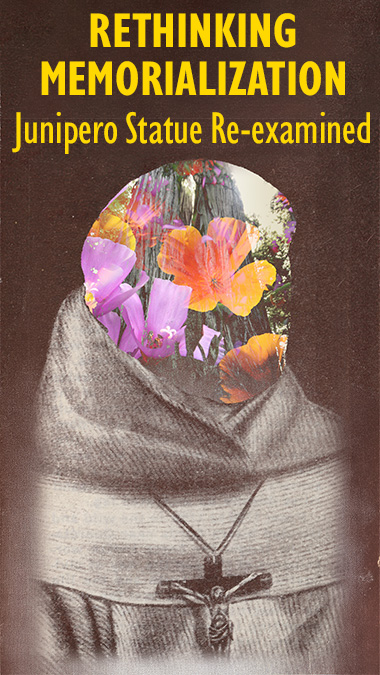
In the context of asking what should be done with the toppled Junípero Serra statue, the PAR research outputs shift the focus away from replacing a monument to a colonizer and toward the living practices of relocated Indigenous people that already sustain memory. They show how Indigenous memory-keeping continues through creative, everyday forms—through sound, movement, storytelling, food, and collective action—despite five centuries of genocide, discrimination, oppression, and invisibilization. At the same time, these practices often persist in conditions of fragility, shaped by displacement, fragmentation, and the partial transmission of knowledge across generations. The collective work of the researchers reframes the question: not what should take the statue’s place, but how institutions can recognize, honor, and support these ongoing creative practices through which Indigenous communities continue to carry and remake memory.
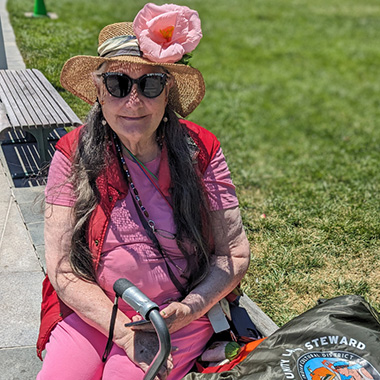
PAR Group 1 – Mary Jean Robertson
Mary Jean Robertson’s video explores community radio as a form of memory-keeping and cultural continuity. Drawing on over five decades of work as a radio host, her contribution situates radio as an oral archive, storytelling practice, and community-based information network. Her work highlights how radio sustains Indigenous knowledge, language, and community connection in urban Native contexts, where distance from ancestral lands requires alternative forms of transmission. Through her reflections, she illustrates how radio has functioned to share community news, document political struggles, and transmit information about weather, emergencies, and local conditions.
Mary Jean also emphasizes the role of tribal and community radio as lifelines—providing language-accessible emergency communication systems that are often unavailable through mainstream media. She describes radio as analogous to the breath patterns of a Native flute: carrying sound, rhythm, and meaning across distance. Her contribution underscores radio not only as a medium of preservation, but as an active, living practice of memory-keeping and collective survival.
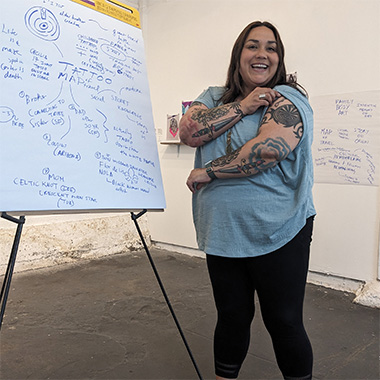
PAR Group 1 – Cecilia Melleion
Cecilia Melleion presents an exploration of the Man in the Maze (I’itoi) and tattooing as forms of remembrance. Through a visual “tattoo map” and accompanying reflections, she traces how personal, familial, and cultural memory are carried on the body across time and place. Her work connects early experiences, such as childhood tattooing practices and family teachings, with broader cultural understandings of the Man in the Maze as representing the path of life and its endpoint. She frames tattooing as both a personal and cultural practice that maps journeys of relocation, identity, and reconnection.
Cecilia emphasizes that memory is not only symbolic but embodied—something that is felt, recognized, and taken in. She describes moments of remembering as acts of recognition, where knowledge exists in the body even when it is not consciously articulated. Her work also addresses the boundaries of cultural knowledge, noting that some forms of understanding are sacred or not meant for external audiences. In this way, her contribution reflects both the transmission and protection of Indigenous knowledge, and positions the body as a living archive of story and origin.
PAR Group 1 – Andrew Vargas
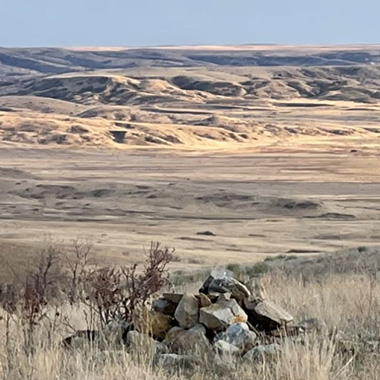
Andrew Vargas contributed through oral reflection and conceptual development rather than a formal media artifact. Drawing from his experience as Lakota participant raised in a relocation community house in Oakland and currently a staff member of the Native American Health Center, and a fire keeper, Andrew explored the theme of unity. His reflections centered on what he described as the “unity of differences”—the coming together of different tribal ideologies and upbringings, forming what he described as an intertwined root system and shared future. He also explored possible symbolic forms that could represent this interconnectedness. His contribution underscores that PAR outputs may take non-material forms, and that conceptual and oral knowledge are equally valid forms of research production.
PAR Group 2 – José Góngora Pat
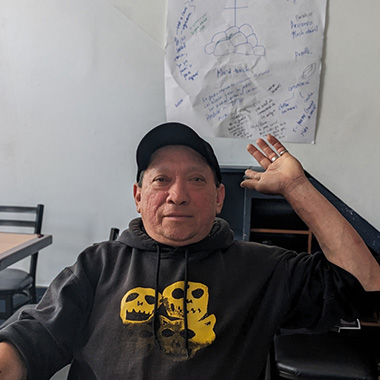
José Góngora Pat produced a video and live installation documenting mool tunich: ancestral path markers and rest points found along walking routes in the forests of Yucatán, used by campesinos tending their milpas. These markers are created by placing stones along paths and are maintained over time through repeated gestures, including pausing to rest, drinking pozol, crossing oneself, adjusting displaced stones, and adding new stones encountered along the way. Through these actions, the mool tunich gradually takes shape.
José describes these sites as places of rest, orientation, and gathering, where individuals recover strength, reconnect with others, and continue their journey. In this sense, mool tunich functions both as a navigational reference and as a practice sustained through repeated use.
His work highlights memory as something embedded in landscape and movement—a practice enacted through walking, pausing, and collective participation across generations.
As part of his presentation at the David Ireland House and the Lunch & Learn, José built a small-scale mool tunich. This act raised questions about how practices rooted in specific ecologies can be carried, adapted, or reinterpreted in displacement. José also reflects on how migration and changing environmental conditions have reduced agricultural activity, leading to fewer people walking these paths and a gradual loss of the practice in his home community. His film was shown on April 7, 2026, at ATA in the Mission, as part of the 10-year remembrance of his brother, Luis Góngora Pat, who was killed by SFPD.
PAR Group 2 – Elías Silvano Hernández
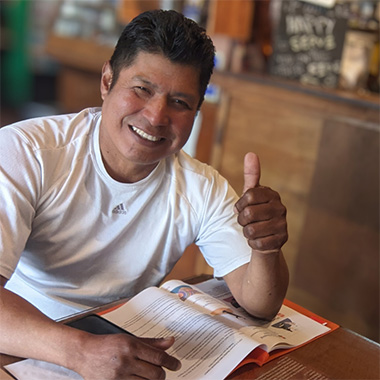
Elías documented and interpreted Voice of the Jungle, a dual reference to both the sounds of the jungle in Palenque, Chiapas, and a community radio station of the same name. His work highlights how environmental sound—such as birds at dawn, shifting sounds at midday, and crickets at night—structures daily life and remains present in memory even after migration. He contrasts these rhythms with urban environments, where such patterns are absent. Elías also recalls how radio functioned as a communication system in the jungle, transmitting messages between families through letters read over the air. In this way, his work connects environmental listening, community communication, and place-based memory.
His contribution positions listening as a form of cultural connection, linking sound, memory, and communication across distance. Elías incorporated videos taken by his uncle from their family ancestral land of howling monkeys and pristine river scene with birdsong in the background. He also shared and credited another artist’s video of the Lacandon jungle at twilight to bring us the light of fireflies and the songs of crickets.
PAR Group 2 – Elena Domingo
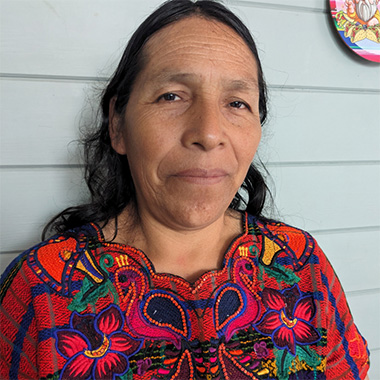
Elena documented the cultivation and care of corn and its connection to cyclical family and community practices among Mayan communities, including her native Mam community in Guatemala, as well as José’s Yucatec Maya community in Mexico and Elías’s Tzeltal community in Chiapas. These include seed exchange, planting, and harvest-related rituals.
Elena incorporated WhatsApp videos sent by her son of their milpa in San Marcos, Guatemala, and two of her favorite TikTok videos showing the valley where she's from, and the abundant harvest of the milpas. As part of her presentation, Elena shares this knowledge through practice and often gifts organic corn seeds to participants. Through this process, seeds emerged as living carriers of cultural continuity—material forms through which knowledge, relationships, and practices are sustained over time.
PAR Group 3 – Dany Ortiz
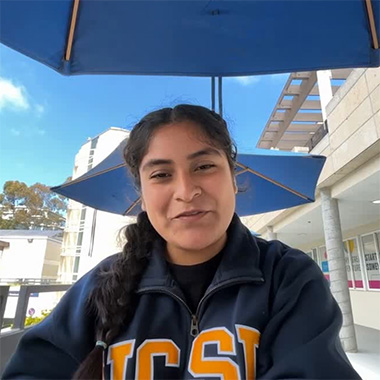
Dany Ortiz documents forms of protest and resistance learned through family and community. Her work reflects how political awareness and action are transmitted through lived experience and intergenerational influence, particularly through her mother and sister. She identifies multiple forms of protest, including marches, public storytelling, speeches, and advocacy aimed at systemic change. Her reflections also address fear as a barrier to participation and emphasize the role of collective presence in overcoming that fear. As part of her research, she created a visual representation of a protest, included in her video.
PAR Group 3 – Siclaly Espinoza
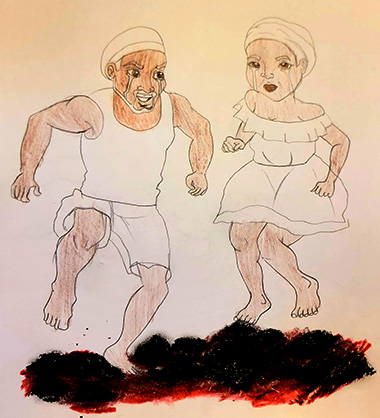
Siclaly Espinoza documented the punta dance of the Garífuna people of Honduras as a form of memory-keeping rooted in Afro-Indigenous Garífuna history. Her work explores the cultural, historical, and symbolic dimensions of punta, including its role in identity, resistance, and the transmission of knowledge. Her research includes written documentation, a video reference, and an original drawing reflecting her interpretation of the practice.
Siclaly also taught participants how to dance punta at the David Ireland House following a shared meal, bringing in an additional form of embodied transmission of memory through movement, rhythm, and collective participation.
PAR Group 3 – Michael Lowe
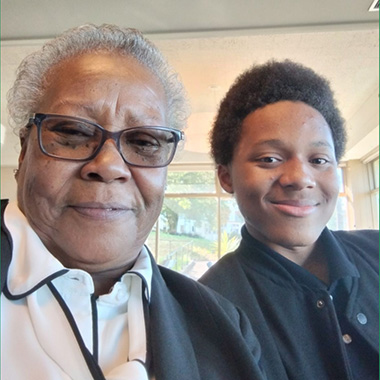
Michael Lowe documented the process of learning to make gumbo from his grandmother, who migrated to San Francisco from New Orleans during the Great Migration and carries both Black and Indigenous roots. He shared his research through practice, preparing and serving gumbo to participants during the gathering at the David Ireland House, emphasizing food as a form of memory, transmission, and community care.